France Tour 2026
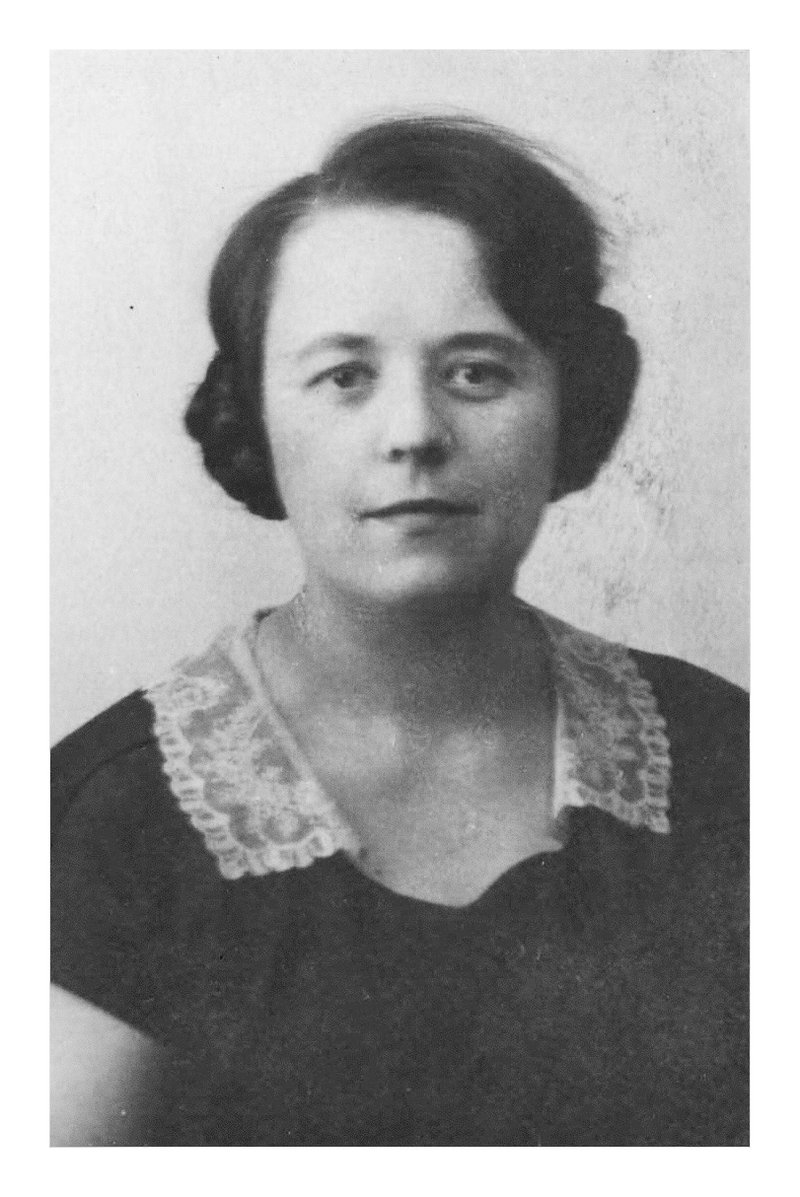
Hommage à Fernande Decruck
The Rediscovery of a Remarkable Composer
In September 2026, French and American musicians come together in France to celebrate the music of Fernande Decruck (1896–1954) through a series of concerts, musical encounters, and discoveries.
Who Was Fernande Decruck?
Fernande Decruck (1896–1954) was a French composer, organist, pianist, and teacher whose career took her from the Paris Conservatoire to concert halls in France and the United States.
A gifted improviser and organist, she performed in New York and composed an unusually diverse body of music—from symphonic and chamber works to music for organ, piano, winds, and saxophone. Her husband, Maurice Decruck, was a double bassist and saxophonist with the New York Philharmonic under Arturo Toscanini, and the family’s years in the United States played an important role in Fernande’s musical life.
During the 1940s, she devoted herself increasingly to composition, producing some of her most ambitious works, including the Concerto for Harp, Poème héroïque, and her celebrated Sonate en ut dièse for alto saxophone (or viola).
After her death at just 57, much of her music fell into obscurity. Today, performers, scholars, publishers, and members of the Decruck family are working together to bring her remarkable musical voice back to the concert stage.
The Music
Fernande Decruck’s music is remarkably diverse. Her catalogue ranges from large orchestral works and concertos to chamber music, works for winds and saxophone, piano and organ music, songs, and even popular music written for film and radio.
Throughout these different genres, we hear a distinctive musical voice: unmistakably French, often lyrical and melancholic, but also playful, rhythmically vibrant, and virtuosic.
The works performed during the France Tour 2026 offer a glimpse into the extraordinary range of her musical world.
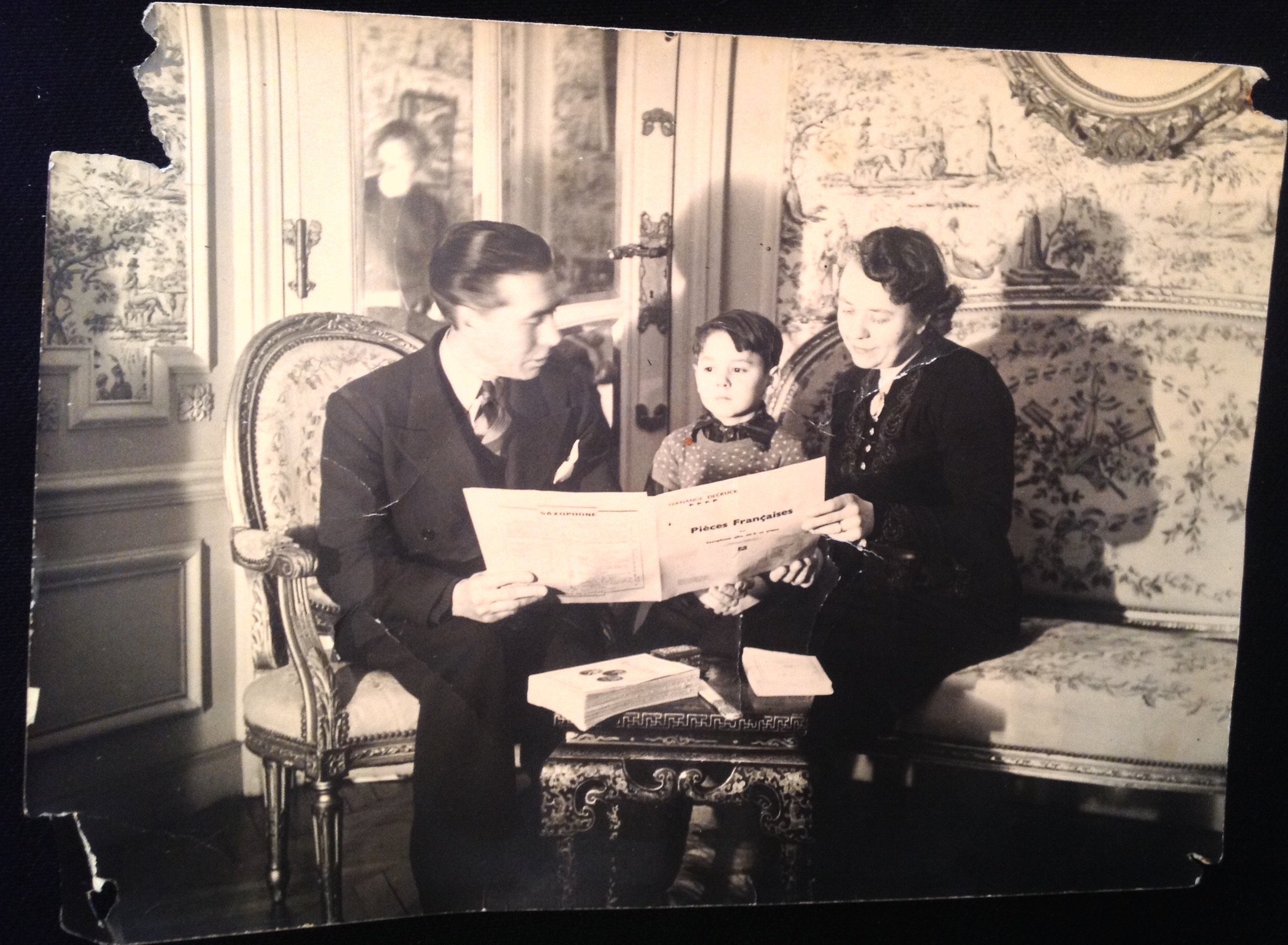
Three Short Works for Violin and Piano
September 12 performance only
The following three short works for violin and piano will be performed exclusively at the September 12 concert at La Loingtaine in Montigny-sur-Loing.
Performed by
Ji Hyun Kim, violin & Jorge González Buajasan, piano
Cantilène (1933)
Decruck frequently adapted her music for different instruments, allowing individual works to take on new colors and reach new performers. Cantilène is best known today among clarinetists, but it also survives in a version for violin and piano, heard during the France Tour 2026.
Brief, lyrical, and expressive, the work reveals the melodic warmth and gentle melancholy that appear throughout Decruck’s music.
Pavane (1949)
Fernande Decruck returned to Pavane repeatedly throughout her career. At least four different versions of the work are known, spanning nearly twenty years—a sign that this was more than simply a practical arrangement of existing music, but a musical idea that continued to resonate with her.
In its lyrical lines and gently flowing character, Pavane reveals one of the most recognizable qualities of Decruck’s voice: an elegant, distinctly French melancholy.
Later in the concert, the same music returns in a very different form—in Decruck’s version for reed trio.
Andante from the Violin Sonata (1942)
This Andante offers a fascinating glimpse into the process of rediscovering Decruck’s music. She wrote the Violin Sonata for the French violinist André Asselin, and among her papers appears the tantalizing note: “bonne copie chez Asselin” (“good copy at Asselin’s”). Today, however, only the violin part is known to survive in the Decruck family archives; the original piano part has been lost.
Fortunately, Decruck later reused the Andante in a version for cello and piano. By comparing the surviving sources, it has been possible to reconstruct the piano accompaniment and bring this portion of the lost Violin Sonata back to life.
Three Works for Reed Trio
Performed by Reeds Amis
Marilyn Cole, oboe
Angela Shankar, clarinet
Melissa Kritzer, bassoon
Capriccio (1933)
Decruck had a particular affinity for wind instruments, and her writing for them often combines instrumental color with long, expressive lines. In Capriccio, the music seems almost constantly in motion—flowing and bubbling like a stream.
Despite its title, this is not simply a light or playful work. Beneath its movement is the wistful, distinctly French melancholy that appears so often in Decruck’s music.
Pavane (1949)
The Pavane heard here is another version of the same music presented for violin and piano at the September 12 concert. Decruck returned to this work repeatedly over nearly twenty years, adapting it for different combinations of instruments.
The reed trio transforms the music once again: the oboe, clarinet, and bassoon give its lyrical lines an entirely different palette of colors while preserving the melancholy at the heart of the piece.
Variations en trio sur l’air du P’tit Quinquin (1933)
Here we encounter a very different side of Decruck: playful, mischievous, and virtuosic.
The work is based on P’tit Quinquin, a traditional song from northern France. Decruck takes this familiar melody and transforms it through a series of imaginative variations, allowing each of the three instruments to display its individual character.
Her use of a traditional melody also anticipates the Noël movement of the Sonate en ut dièse, in which she once again takes familiar music and makes it unmistakably her own.
Two Major Chamber Works
The two most substantial works on the France Tour 2026 represent very different moments in Decruck’s creative life: the early Suite dans le style ancien and the mature Sonate en ut dièse.
Suite dans le style ancien
for string quartet
Written earlier in Decruck’s career, the Suite dans le style ancien reveals her fascination with the musical past. Its title—“Suite in the Old Style”—refers to the Baroque dance suite, a form Decruck reimagines through her own twentieth-century French musical language.
Across six movements—Prélude, Courante, Passepied I & II, Sarabande, and Gigue—Decruck combines the elegance and formal clarity of earlier French music with her own distinctive harmony, lyricism, and instrumental color.
The result is not an imitation of Baroque music, but a conversation between past and present.
Performed by
Ji Hyun Kim, violin I
Manon Galy, violin II
Léa Hennino, viola
Héloïse Luzzati, cello
Sonate en ut dièse
for alto saxophone (or viola) and piano/orchestra
Fernande Decruck’s Sonate en ut dièse is her best-known work and one of the finest examples of her mature musical language. Dedicated to the legendary French saxophonist Marcel Mule, the Sonata combines Classical forms with impressionistic harmony, moments of polytonality, lyrical writing, and considerable virtuosity.
Decruck created versions with piano and with full orchestral accompaniment, and the solo part may be performed on either alto saxophone or viola. For the France Tour 2026, Mitsuru Kubo performs the viola version in a chamber arrangement with strings and piano.
The Four Movements
I. Modéré et très expressif
The Sonata begins mysteriously before opening into a broad, pastoral melody. Soloist and ensemble move between intimate dialogue and more expansive, expressive writing.
II. Noël
Decruck incorporates the traditional French carol Noël nouvelet (“Christmas Comes Anew”), transforming the familiar melody through her own harmonic language. Its melancholy character offers another example of her fascination with reimagining traditional melodies—something also heard in the Variations en trio sur l’air du P’tit Quinquin.
III. Fileuse
Meaning “spinning,” Fileuse takes the traditional place of the scherzo. Rapid, flowing passagework gives the soloist an opportunity for considerable virtuosity. Marcel Mule himself recorded this movement—an especially significant connection between the Sonata and the saxophonist to whom Decruck dedicated it.
IV. Nocturne et Final
The final movement begins with a dark and mysterious Nocturne, at times evoking the character of a funeral march, before transitioning into a more animated final section that brings the Sonata to a heroic conclusion.
A Work in Evolution
The surviving sources suggest that Decruck continued to revise the Sonata after completing an initial version. In her manuscript, she crossed out and replaced certain movement titles and tempo markings.
A contemporary 1943 notice in the Paris magazine Musique et Radio is therefore particularly revealing. Its description of the movements corresponds in several respects to the earlier markings still visible beneath Decruck’s revisions in the manuscript.
The article describes the work as freer than a conventional sonata—almost a suite—and praises its “musique franche, spontanée” (“direct, spontaneous music”). It also identifies the work specifically as a Sonata for saxophone and piano, while noting the existence of both an orchestral version and a publication for viola and piano.
Taken together, the manuscript and contemporary account offer a fascinating glimpse of Decruck continuing to shape the identity of the Sonata as it moved toward publication.
Marcel Mule and the Sonata
Decruck dedicated the Sonata to Marcel Mule, one of the most influential saxophonists of the twentieth century and a central figure in establishing the saxophone as a classical concert instrument.
A newspaper listing preserved by the Bibliothèque nationale de France documents a radio broadcast on August 11, 1943, featuring Marcel Mule and André Collard performing Decruck’s Sonate. Mule also recorded the Fileuse movement—an important connection between the work and its dedicatee.
Performed by
Mitsuru Kubo — solo viola
Manon Galy — violin I
Ji Hyun Kim — violin II
Léa Hennino — viola
Héloïse Luzzati — cello
Jorge González Buajasan — piano
Matthew Aubin — conductor
Listen to Movement 1 on YouTube
Published by Éditions Billaudot
Rediscovering Fernande
For decades after Fernande Decruck’s death in 1954, much of her music remained unpublished, unperformed, or known only through manuscripts preserved by her family.
Her rediscovery has been a collaborative effort. Members of the Decruck family, performers, researchers, publishers, and musical institutions in France and the United States have worked to locate manuscripts, prepare new editions, record previously unknown works, and return her music to the concert stage.
In recent years, that work has accelerated dramatically. Works unheard for generations are being performed and recorded again, while new editions are making Decruck’s music available to musicians around the world.
The France Tour 2026 is part of that continuing story—bringing French and American musicians together in the country where Decruck’s remarkable musical journey began.
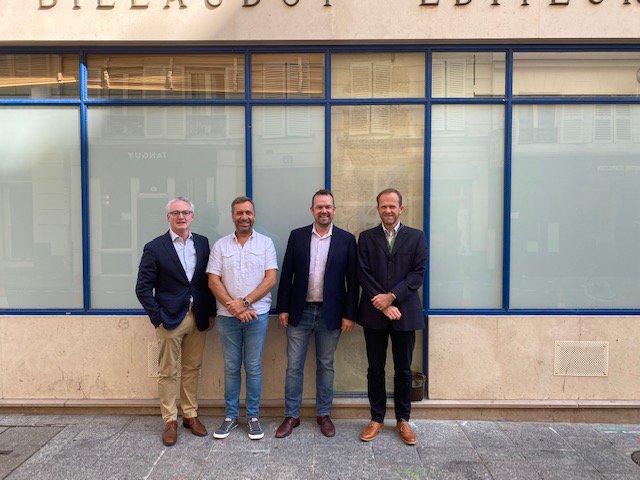
Christophe Dardenne, Nicolas Prost, Matthew Aubin, Jean-Michel Issartel
France Tour 2026 — The Concerts
📅 Thursday, September 10 7:00 PM
📍Auditorium Lounès Matoub
53 avenue de Fontainebleau - Le Kremlin-Bicêtre
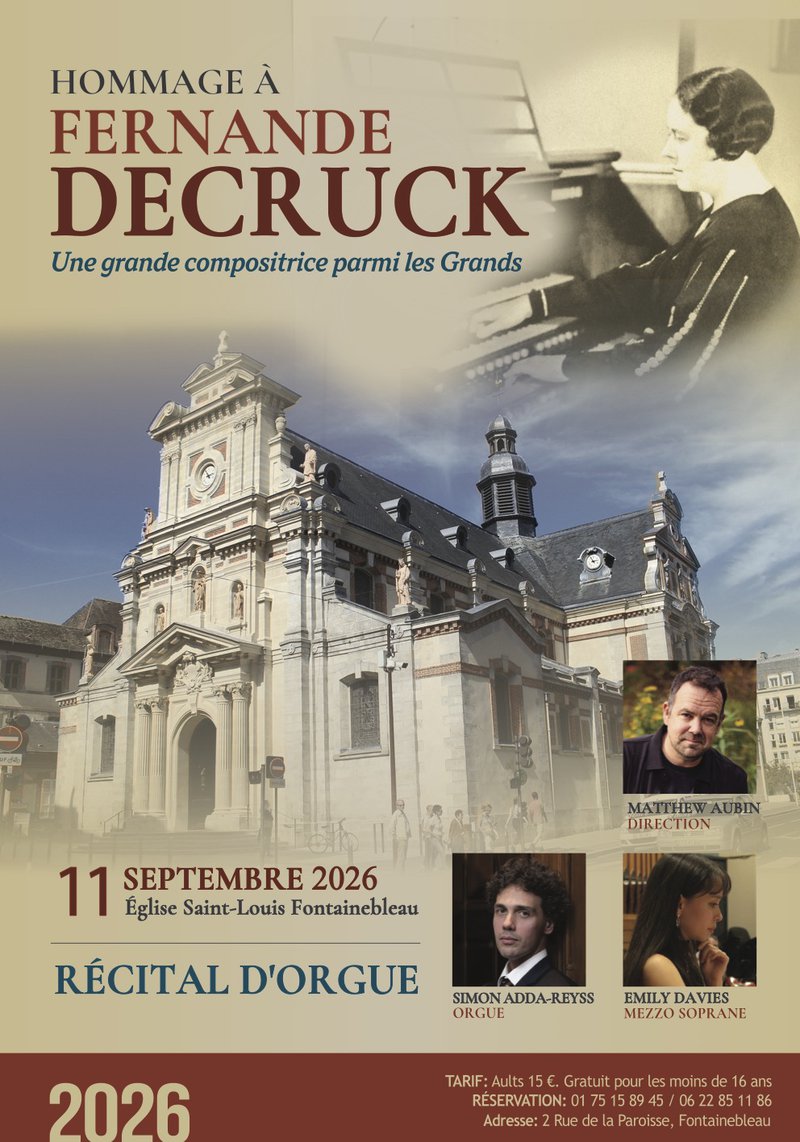
📅 Friday, September 11 7:00 PM
📍Église de Saint-Louis Fontainebleau
2 Rue de la Paroisse - Fontainebleau
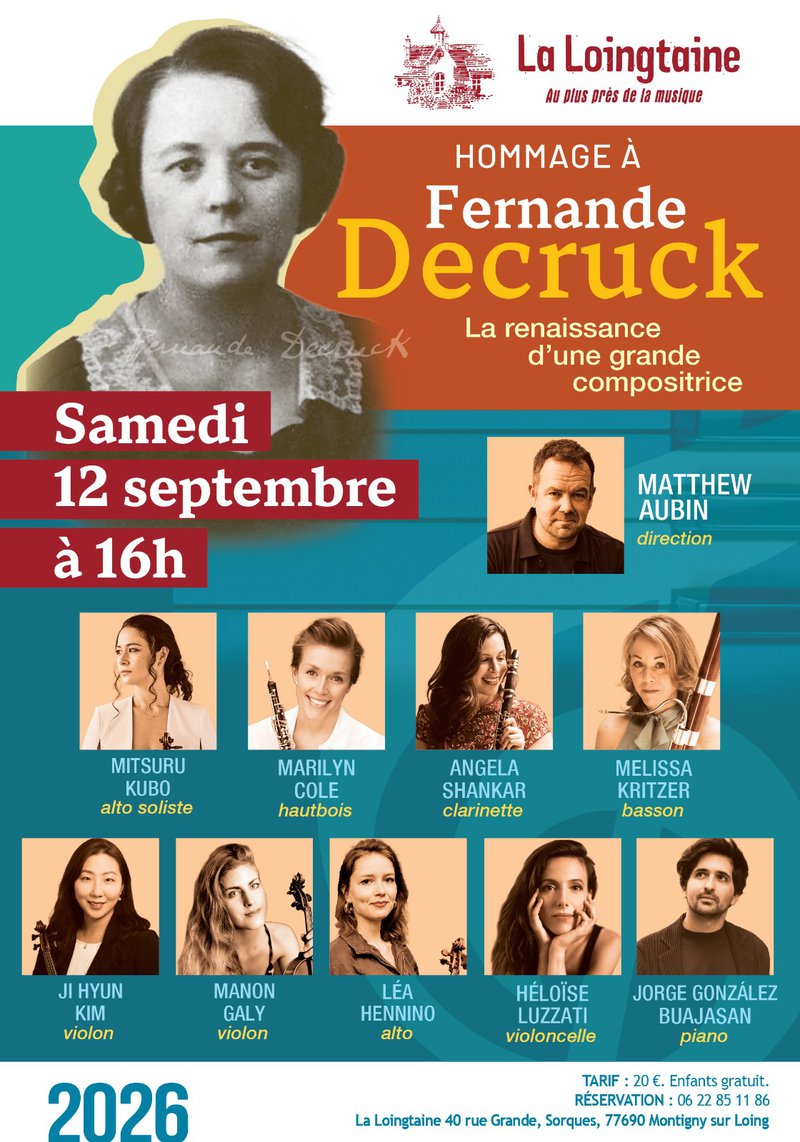
📅 Saturday, September 12 4:00 PM
📍La Loingtaine
40 rue Grande - Sorques, Montigny-sur-Loing
The Musicians
The France Tour 2026 brings together musicians from France and the United States, united by a shared commitment to chamber music and the rediscovery of Fernande Decruck’s work.
Marilyn Cole — oboe
An American oboist and educator, Marilyn Cole studied at the Eastman School of Music and has performed in orchestral, chamber, and Broadway settings. She is a founding member of Reeds Amis, whose work has helped bring Decruck’s music for reed trio to new audiences.
Angela Shankar — clarinet
New York–based clarinetist, multi-instrumentalist, and educator Angela Shankar studied at Carnegie Mellon University and the Eastman School of Music. A founding member of Reeds Amis, she performs across orchestral, Broadway, chamber, and contemporary music.
Melissa Kritzer — bassoon
Bassoonist Melissa Kritzer has performed with ensembles including the Orchestra of St. Luke’s, Albany Symphony, New Jersey Symphony, and Hartford Symphony. Her work with Reeds Amis has included transcribing, performing, and recording Decruck’s music for reed trio.
Ji Hyun Kim — violin
Violinist and violist Ji Hyun Kim is Assistant Professor of Music and Director of Orchestra and String Studies at Albion College in Michigan. She is also the founder of the ConTempus Initiative, dedicated to collaboration and contemporary music.
Manon Galy — violin
French violinist Manon Galy was named Révélation Soliste Instrumental at the 2022 Victoires de la Musique. A prize-winning soloist and chamber musician, she has studied in Paris, Munich, and at the Queen Elisabeth Music Chapel.
Mitsuru Kubo — viola
American violist Mitsuru Kubo has appeared in venues including Carnegie Hall, Lincoln Center, and the Kennedy Center. A longtime collaborator with Matthew Aubin, she performs the solo viola part in Decruck’s Sonate en ut dièse during the France Tour 2026.
Léa Hennino — viola
French violist Léa Hennino studied at the Conservatoire National Supérieur de Musique de Paris and subsequently with Nobuko Imai and Lawrence Power. An active chamber musician, she is also closely involved with La Cité des Compositrices and its work recovering music by women composers.
Héloïse Luzzati — cello
Cellist Héloïse Luzzati is the founder and artistic director of La Cité des Compositrices, an organization devoted to researching, performing, recording, and promoting music by women composers. In recognition of her work, she was named a Chevalier de l’Ordre des Arts et des Lettres in 2023.
Jorge González Buajasan — piano
Cuban-born pianist Jorge González Buajasan moved to Paris at the age of fifteen and studied at the Conservatoire National Supérieur de Musique de Paris. An acclaimed soloist and chamber musician, he has received prizes at the KlavierOlymp, Clara Haskil, and Lyon International Chamber Music competitions.
Matthew Aubin — conductor
American conductor and Decruck scholar Matthew Aubin is Music Director of the Jackson Symphony Orchestra and Southwest Michigan Symphony Orchestra and Artistic Director of The Chelsea Symphony. His research, performances, editions, and recordings have played an important role in the modern rediscovery of Fernande Decruck’s music.
Listen to Fernande
The music performed during the France Tour 2026 represents only a small part of Fernande Decruck’s remarkable catalogue. Discover more of her orchestral, chamber, and concertante music through recent recordings and performances.
Acknowledgments
I am deeply grateful to Alain and Jeannine Decruck, Hélène Decruck, Michèle “Mimi” Duvauchelle, Claudine “Coco” Scott, and the entire Decruck family for welcoming me so generously into Fernande’s life and legacy, opening their family archives, sharing their memories, and supporting the continuing rediscovery of her music. I owe a special debt of gratitude to Hélène, whose remarkable research and preservation work laid much of the foundation for everything that followed.
The France Tour 2026 has been made possible through the generosity and collaboration of many friends and partners in France. My particular thanks to Masako Saulière and La Loingtaine for welcoming us to Montigny-sur-Loing; to Pascal Zavaro, Joachim Leroux, Pascale Lambert, and the Conservatoire du Kremlin-Bicêtre for helping make our Paris-area performance possible.
I am also deeply grateful to Héloïse Luzzati and La Cité des Compositrices for their friendship, advocacy, and commitment to bringing the music of women composers back to life, and to Éditions Billaudot for its continuing work to make Decruck’s music available to performers today.
In the United States, the Jackson Symphony Orchestra and the Equal Billing project have been central to the modern rediscovery of Decruck’s music through performances, recordings, research, and new editions. I am profoundly thankful to the orchestra’s musicians, staff, board, donors, and supporters for believing in this work.
Finally, my thanks to all of the French and American musicians participating in France Tour 2026, who have come together to give Fernande’s music a voice in the country where her extraordinary musical journey began.